
A Guide for Business Leaders
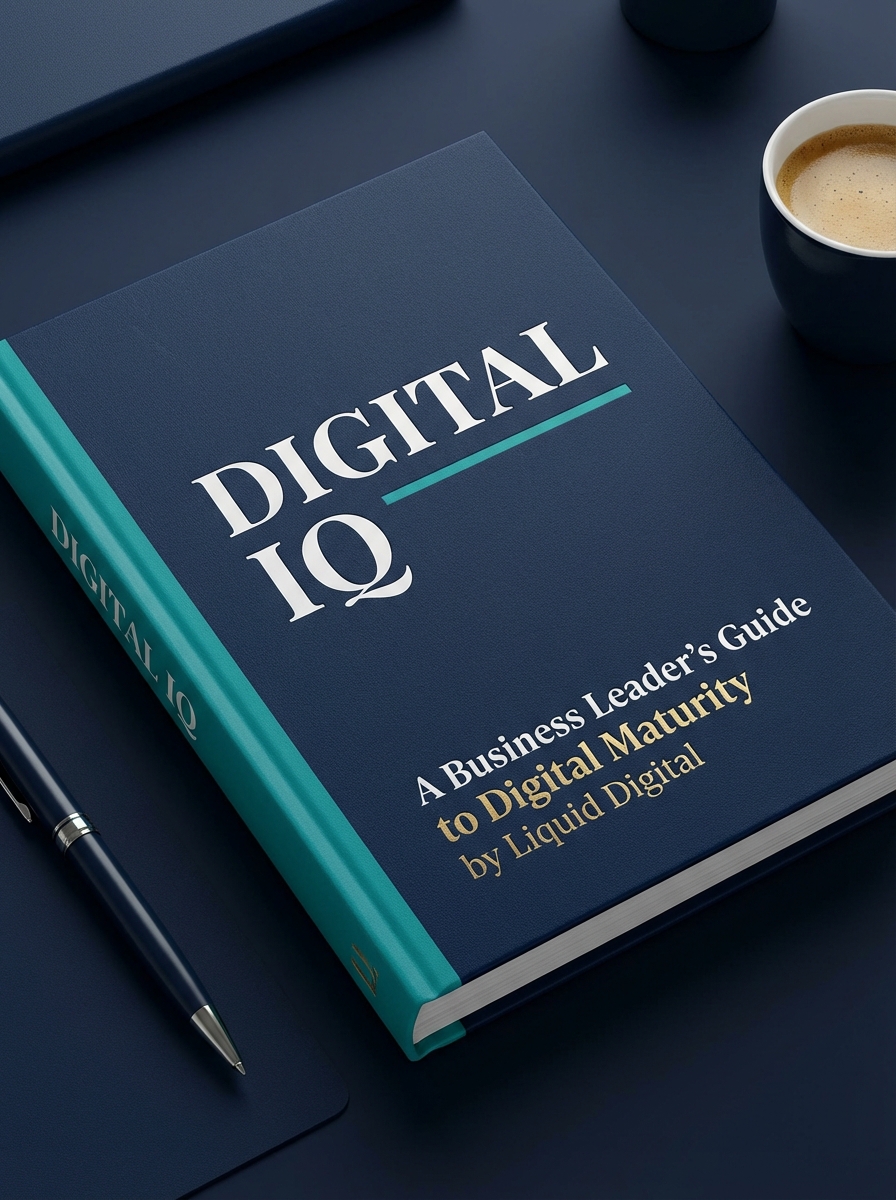
Digital IQ
The measure of how well your business thinks, operates, and competes in the digital age.
Introduction
The gap between digital ambition and digital performance is wider than most leaders realise.

Most organisations have some digital activity. Very few have digital intelligence.
There is a meaningful difference between having a website, running some paid media, and using a few software tools: and genuinely understanding how digital drives your business. Most organisations are operating somewhere in the middle: active, but not intelligent.
That difference is what we call Digital IQ.
Digital IQ is not a technology metric. It is a business metric: a measure of how clearly your organisation thinks about digital, how deliberately it invests, and how effectively it executes across every dimension of the digital economy.
The organisations winning in the digital economy are not the ones with the biggest budgets. They are the ones who think most clearly about what digital is actually for.
Michael Soden, Founder, Liquid Digital
This guide sets out the six pillars of Digital IQ: the dimensions that, together, determine whether your organisation is a digital leader, a digital follower, or at risk of being left behind entirely.
Common misconceptions
What Digital IQ is not
Digital IQ is not the number of channels you are active on. Presence is not the same as performance. Having accounts on every platform costs time and resources, and delivers nothing unless the strategy behind them is sound.
It is not the size of your technology stack. More tools do not create more intelligence: they create more complexity. Organisations with genuine Digital IQ often run leaner technology environments, because they are more deliberate about what they adopt and why.
It is not a function owned by marketing, or IT, or the agency you engage. Digital IQ is a whole-of-business capability. It requires leadership buy-in, cross-functional alignment, and a shared understanding of what digital is actually for in your organisation.
And it is not fixed. Digital IQ can be built deliberately, with the right frameworks, the right partners, and the right commitment. That is what this guide is designed to help you do.
The Framework
Six pillars. One integrated intelligence.
Each pillar represents a critical dimension of your organisation’s digital capability. Together they form an integrated system: strengthen one and you amplify the others.

Strategic Advisory
Digital strategy aligned with your business vision, shaping every initiative that follows.

Brand – Communications
Brand consistency at every touchpoint, across platforms and channels.

Technology – Data
Platforms and data infrastructure optimised for efficiency at scale and real business intelligence.

Experience Design – Creative
Engaging digital experiences designed around real people, building trust at every touchpoint.
Marketing – Growth
Getting your message to the right people and driving the results that actually matter.

Security – Compliance
Secure and scalable digital ecosystems built for governance, risk and compliance.
Why integration matters
Organisations frequently invest in individual pillars in isolation. A new website without a digital strategy. Paid media without brand foundations. Technology investment without the experience layer. Isolated investment produces isolated results. Digital IQ compounds when all six pillars are developed together.

Pillar 01
Strategic Advisory
Every digital investment your organisation makes is either guided by strategy or driven by reaction. Organisations with high Digital IQ in this pillar know exactly what they are trying to achieve digitally, why, and in what order. They have a documented digital strategy that is reviewed regularly and connected directly to their business objectives.
Organisations with low Digital IQ in strategy are busy: but busy in the wrong directions. They respond to trends, duplicate effort across teams, and cannot articulate what success looks like beyond vanity metrics.
What good looks like
A documented digital strategy reviewed quarterly, with clear KPIs for each pillar, executive sponsorship, and a prioritised initiative roadmap aligned to the annual business plan.
Decisions are made reactively: a competitor launches something, and you follow. There is no documented strategy, or the last one was written three years ago.
The digital strategy is a living document. Every major initiative can be traced back to a strategic objective, and the team can articulate why each project is being done now.
Can your leadership team articulate your digital strategy in one sentence? Does your agency know what business outcomes you are trying to achieve? When was your strategy last reviewed?
Commission a digital strategy review. Map your current digital initiatives against your business objectives. Identify the gaps and the overlaps. Then prioritise ruthlessly.

Pillar 02
Brand & Communications
In the digital age, your brand is experienced more often online than anywhere else. Every touchpoint: a Google search result, a social media post, a webpage, an automated email: either builds or erodes trust. Organisations with high Digital IQ in brand have achieved consistency across every channel and every format.
They have documented brand standards that extend to digital, a content strategy that serves their audience rather than just their own interests, and communications that sound like a coherent organisation rather than a collection of disconnected departments.
Different colours, fonts, and tones across channels. Social media that looks nothing like the website. Marketing emails that do not reflect the brand. A logo that has been stretched.
Consistent visual and verbal identity from the website to the email footer. A content calendar that reflects a genuine point of view. Communications that earn attention rather than just filling space.
Could a customer identify your brand from any single touchpoint, without seeing your name? Does your team have clear guidance on how to write and design for digital? Who owns brand in your organisation?
Audit every digital touchpoint your customers experience. Score them for brand consistency. Start with the highest-volume, highest-impact channels: usually your website, email, and primary social platform.

Pillar 03
Technology & Data
Technology is the infrastructure of Digital IQ. But more technology is not better technology. Organisations with high Digital IQ have a technology stack that serves their strategy: not the other way around. They know what data they are collecting, what it is telling them, and how to act on it. They have fewer tools, better connected, producing cleaner insights.
Low Digital IQ in technology looks like tool proliferation: a CRM that nobody trusts, an analytics platform that nobody reads, a stack of subscriptions that are renewed automatically because nobody has the time to evaluate them.
The data question
The most important data question is not ‘what are we collecting?’ It is ‘what decisions are we making with it?’ If you cannot name a business decision that changed because of your data in the last 90 days, your data infrastructure is decorative.
Multiple disconnected platforms, duplicate data, no single source of truth. Reports that nobody acts on. Technology decisions made by IT in isolation from marketing and operations.
An integrated stack where data flows between systems. A clear owner for each platform. Regular review of tool performance and ROI. Business decisions visibly influenced by data.
Can you name the three most important metrics in your business right now? Who owns your data strategy? How long does it take to answer a basic business question with data?
Map your current technology stack. Identify what is integrated, what is siloed, and what is unused. Then define the three decisions you most need data to inform: and build backwards from there.

Pillar 04
Experience Design & Creative
Your website, your app, your digital touchpoints: these are the physical manifestation of your brand in the digital world. Organisations with high Digital IQ design these experiences around the needs of real people, not around internal org charts or the preferences of the last person who redesigned the website.
High-IQ experience organisations conduct user research. They test their assumptions. They measure engagement not just in sessions but in meaningful actions. They understand that a beautiful website that does not convert is not a success: it is an expensive piece of decoration.
Website navigation designed around internal departments. Forms that ask for more information than necessary. A mobile experience that was never properly tested. A homepage that speaks to the organisation rather than to the customer.
Navigation designed from user journeys. Conversion rates tracked and actively optimised. Mobile experience given the same attention as desktop. Regular usability testing with real users.
When did you last test your website with real users? Do you know where people are dropping off in your conversion funnel? Does your homepage answer the question ‘am I in the right place?’ within three seconds?
Run a conversion rate audit on your five most important pages. Identify the single biggest point of friction in your customer journey. Fix that first.

Pillar 05
Marketing & Growth
Digital marketing is the most measurable form of marketing ever invented: and yet most organisations still cannot clearly articulate what their digital marketing investment is returning. Organisations with high Digital IQ in marketing have moved beyond channel activity to demand generation: they understand the full funnel, they attribute revenue to campaigns, and they continuously optimise based on what the data is telling them.
They also understand the relationship between paid and organic, between brand and performance, between short-term acquisition and long-term retention. They have a growth model, not just a media plan.
The attribution problem
Most organisations are either over-attributing to last click (which over-credits paid search and under-credits brand-building) or not attributing at all (which means every campaign looks equally successful until revenue stops growing). Neither is intelligence.
Marketing activity measured only by reach and impressions. No clear connection between campaign spend and revenue. Different agencies or team members running channels without coordination.
Full-funnel measurement from awareness to revenue. Regular channel performance reviews with clear ROI benchmarks. Paid and organic strategy designed to work together.
What is your cost of customer acquisition? What is your customer lifetime value? Can you attribute revenue to specific campaigns? When did your marketing strategy last change based on performance data?
Define your primary growth metric: the one number that tells you whether marketing is working. Build your attribution model around that metric. Then restructure your reporting to lead with it.

Pillar 06
Security & Compliance
Security is no longer a concern only for large enterprises. Cyber incidents cost Australian small and medium businesses an average of $46,000 per incident: and the reputational damage can be far greater. Organisations with high Digital IQ treat security and compliance as a business requirement, not an IT afterthought. They have documented policies, trained their people, and regularly tested their exposure.
Privacy compliance: the Australian Privacy Act, GDPR where applicable: is not a legal formality but a trust signal. Consumers increasingly make decisions based on how organisations handle their data. High-IQ organisations use compliance as a competitive advantage, not just a risk management activity.
Passwords shared via email. No multi-factor authentication. Privacy policy last updated in 2019. No incident response plan. Security reviewed only after something goes wrong.
MFA enforced across all critical systems. Regular security audits. Staff trained in phishing awareness. Privacy policy current and compliant. Incident response plan tested annually.
When did you last conduct a security audit? Is MFA enforced on your email and key business systems? Do you know where all your customer data is stored and how it is protected?
Start with the basics: enable MFA on all business-critical systems today. Then commission a security assessment to understand your current exposure and prioritise remediation.
Self-Assessment
Where does your organisation stand?
The following questions are not exhaustive, but they are honest. Answer yes only if you can point to evidence.
Strategic Advisory
Do we have a documented, current digital strategy connected to our business objectives?
Brand & Communications
Is our brand identity consistent across every digital touchpoint our customers experience?
Technology & Data
Can we name a business decision made in the last 90 days that was directly influenced by our data?
Experience Design
Have we tested our primary digital experience with real users in the last 12 months?
Marketing & Growth
Can we attribute revenue to specific digital marketing campaigns?
Security & Compliance
Is multi-factor authentication enforced on all our critical business systems?
0 of 6 answered
Our approach
We do not sell services. We build Digital IQ.
Most digital agencies sell outputs: websites, campaigns, reports. We sell something different. We sell organisational capability: the kind that does not disappear when the engagement ends.
We work with business leaders who have recognised that their digital performance is not matching their ambition, and who want a structured, honest assessment of where they stand and a clear plan for getting better.
Our engagements follow a four-stage methodology that takes you from diagnosis to embedded capability. The stages are sequential, but the pace is yours to set.
We are not generalists. Every member of the Liquid Digital team is a practitioner: someone who has built, run, or transformed digital functions inside organisations like yours.
Final thought
The organisations that will lead their categories in the next decade are building their Digital IQ today.
Not with a single project or a new website. With a sustained, deliberate commitment to building capability across all six pillars: strategy, brand, technology, experience, marketing, and security: working as an integrated whole.
If this guide has prompted useful questions about your own organisation's Digital IQ, we would be glad to continue the conversation.

Get the Digital IQ eBook as a PDF
Enter your work email and we’ll send you the PDF instantly. No spam — unsubscribe any time.
Your information is handled in accordance with our Privacy Policy. No spam.
Frequently asked questions
Digital IQ is a measure of how effectively your business uses digital strategy, brand, marketing, experience design, technology, and security to drive growth. It goes beyond having a website or running ads — it reflects the maturity and integration of all your digital capabilities.
This guide is written for business owners, CEOs, and marketing leaders who want a clear framework for understanding where their digital performance stands and what to prioritise next. No technical background required.
Yes. Enter your work email and we will send you the PDF instantly. We do not share your details with third parties. You can unsubscribe from our communications at any time.
Most maturity models focus on technology adoption. The Digital IQ framework is built around business outcomes, covering six performance pillars that span strategy, brand, marketing, design, technology, and security. It is designed for SMEs and mid-market businesses, not enterprise IT departments.
You can take our free Digital IQ assessment online to get a scored diagnostic across all six pillars, with specific recommendations for your business. Most clients find the assessment takes around 10 minutes.